Join Our Mailing List
Get the Latest on Physical AI

Bringing AI to the physical world is notoriously difficult. From factory robots to self-driving cars, autonomous systems must continuously process sensor data and coordinate multiple tasks through complex processor architectures, all while making real-time decisions under strict power, latency, and safety constraints.
Physical AI systems have historically been incubated on legacy GPUs, forcing developers to accept high costs, architectural complexity, and severe power constraints. Despite these inefficiencies, teams remain tethered to this ecosystem by the steep engineering risks of migration. Until now, developers lacked a seamless alternative optimized for Physical AI performance.
When the market can’t break free of a proprietary ecosystem, this dependency leads to architectural, financial, and operational vulnerabilities. Critically, a moat built on switching costs exacts a significant opportunity cost, discouraging the exploration and adoption of potentially better alternatives. The industry has accepted this constraint for far too long.
Today, we are dismantling that constraint. We are launching Palette Neat, the industry’s first agentic development environment for Physical AI. When paired with our production-ready Modalix MLSoC System-on-Module (SoM), which is pin-for-pin compatible with NVIDIA’s Orin SoM, together, they eliminate the legacy GPU moat and fundamentally transform the economics of deploying Physical AI at scale.
Frictionless GPU-to-SiMa.ai Migration
To address the hardware friction, we designed our Modalix SoM to match the Orin SoM form factor, pin-for-pin. This means a seamless, drop-in replacement that requires no carrier board redesign, yet delivers definitive performance-per-watt advantages for Physical AI.
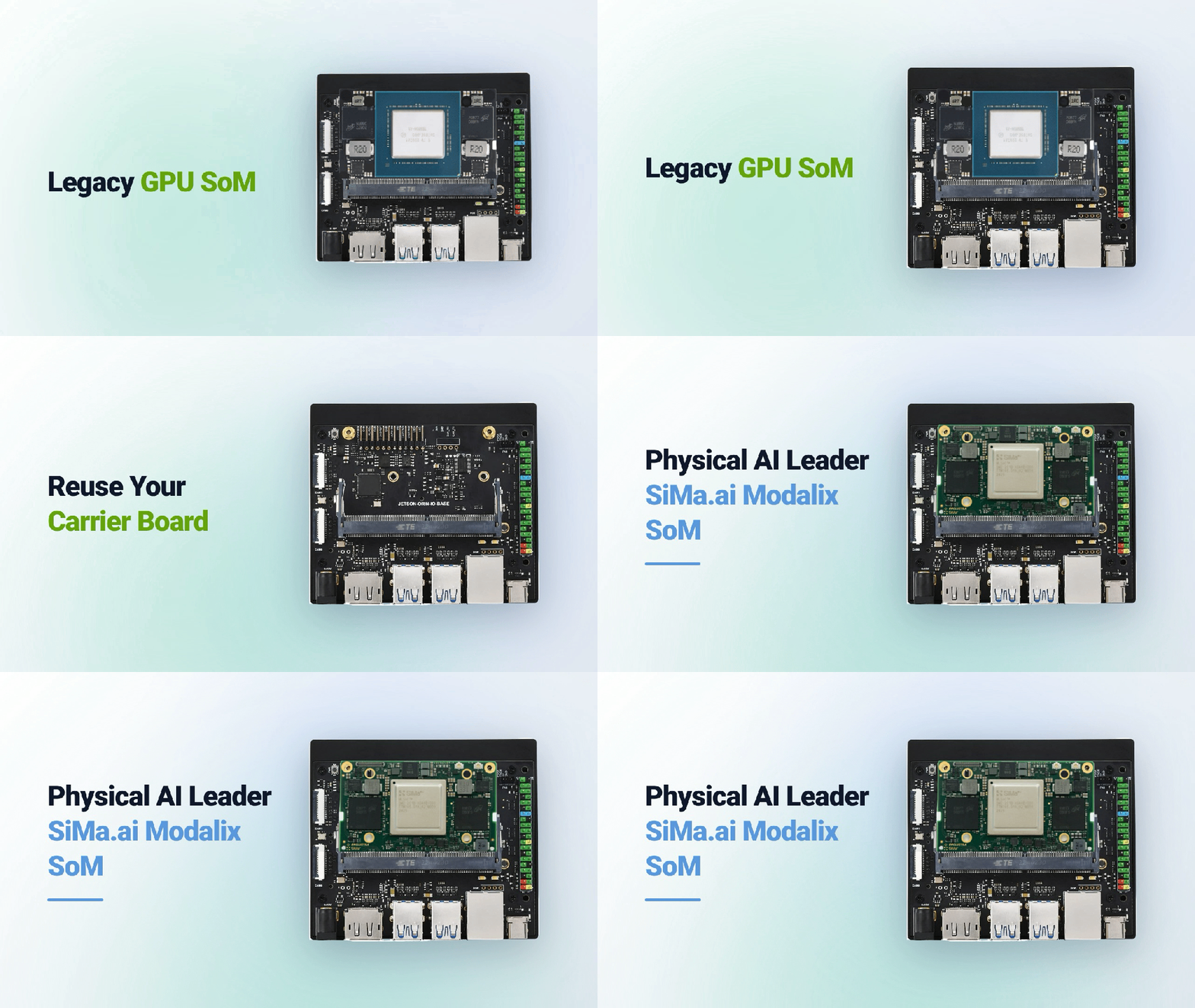
But hardware compatibility is only half the equation. Traditionally, once a chip is swapped, massive engineering hours must be invested just to rewrite the software stack. It’s a massive sunk cost that stalls innovation. Palette Neat eliminates this complexity entirely by introducing a new paradigm: using AI to deploy Physical AI. Rather than rewriting applications from scratch, developers can retain approximately 90% of their existing codebase, dramatically reducing development effort, cost, and platform transition risk.
Instead of spending months on manual porting and integration, an autonomous agent layer handles the
Challenging the Incumbent
What used to require a rack of power-hungry GPUs now runs on a single chip in your hand.
On a single Modalix SoM, we run multiple Large Language Models (LLMs) concurrently alongside vision and sensor models—all under a strict, sub-10W power envelope.
This is what Physical AI actually demands: language-driven reasoning fused with real-time perception, operating safely within the strict thermal budgets of Physical AI systems across robotics, automotive, drones, industrial automation, aerospace and defense, smart vision, and healthcare.
low-level compute plumbing. Developers can now define their system requirements in plain English rather than writing thousands of lines of rigid code.
Imagine a developer simply typing: ‘I have 16 cameras, two LiDARs, and one radar. Fuse this data. I want this performance, at this latency, within this power envelope.’
The agentic workflow takes over, mapping this entire pipeline directly to the silicon. We are compressing development timelines from months down to days—and in many cases, hours. The business outcome is transformative: engineering resources shift from hardware plumbing to high-value differentiation, bringing products to market faster.
Challenging the Incumbent
What used to require a rack of power-hungry GPUs now runs on a single chip in your hand.
On a single Modalix SoM, we run multiple Large Language Models (LLMs) concurrently alongside vision and sensor models—all under a strict, sub-10W power envelope.
This is what Physical AI actually demands: language-driven reasoning fused with real-time perception, operating safely within the strict thermal budgets of Physical AI systems across robotics, automotive, drones, industrial automation, aerospace and defense, smart vision, and healthcare.
The Future of Physical AI is Software-First
SiMa.ai is an AI software-first company that builds its own silicon. Our platform is purpose-built for the two things the market cares about most: performance-per-watt and scalability.
Because AI models evolve in weeks while silicon operates on multi-year development cycles, we shifted complex computing functions traditionally locked in rigid hardware into an intelligent software-driven platform. This architecture allows our Physical AI hardware to update at the speed of software releases. This unlocks the full capabilities of our hardware, adapting to the dynamic demands of Physical AI as it scales from prototype into production.
We are delivering technology purpose-built for the era of Physical AI. Rather than trying to retrofit a power-hungry data center GPU for the edge, we deliver energy-efficient performance in stark contrast to the incumbent.
Winning the next AI race
The first AI race between hyperscalers was won on raw compute power in the cloud. The second AI race — Physical AI — will be won on deployment velocity, power efficiency, and the ability to bring reasoning to systems operating in the real world at scale.
Scaling Physical AI will always require intentional engineering, but it should no longer require wasting months on the wrong problems.
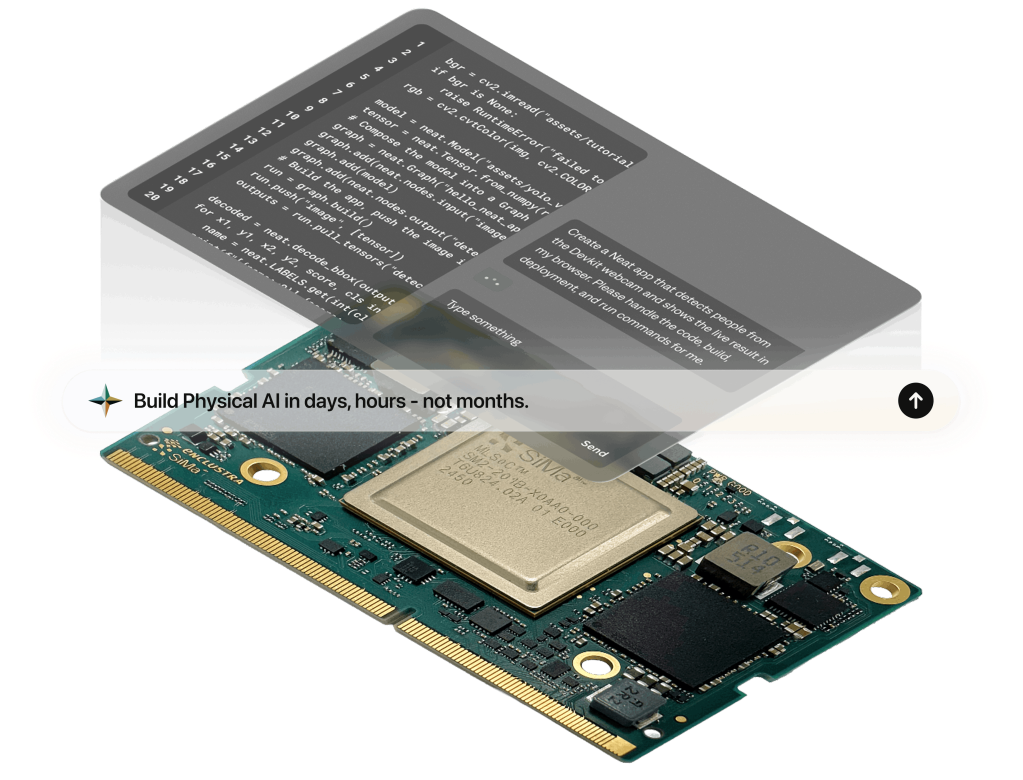
Our Palette Neat agentic AI development environment is an industry first, seamlessly integrating an execution library purpose-built for Physical AI, enabling both productivity and unmatched quality of results in record time. Built from the ground up for this new era, our optimized hardware-software platform dismantles the legacy GPU moat. It is a win for developers, an essential evolution for the market, and the catalyst the industry needs to efficiently deploy Physical AI at scale.
Related resources